Ph.D.
Department of Geography
Vidyasagar University
Midnapore, West Bengal
India, Midnapore-721102, India
Period: 2018-2022


A 'Geographer' with research interests in 'Urban Geography' and 'Regional Planning'.
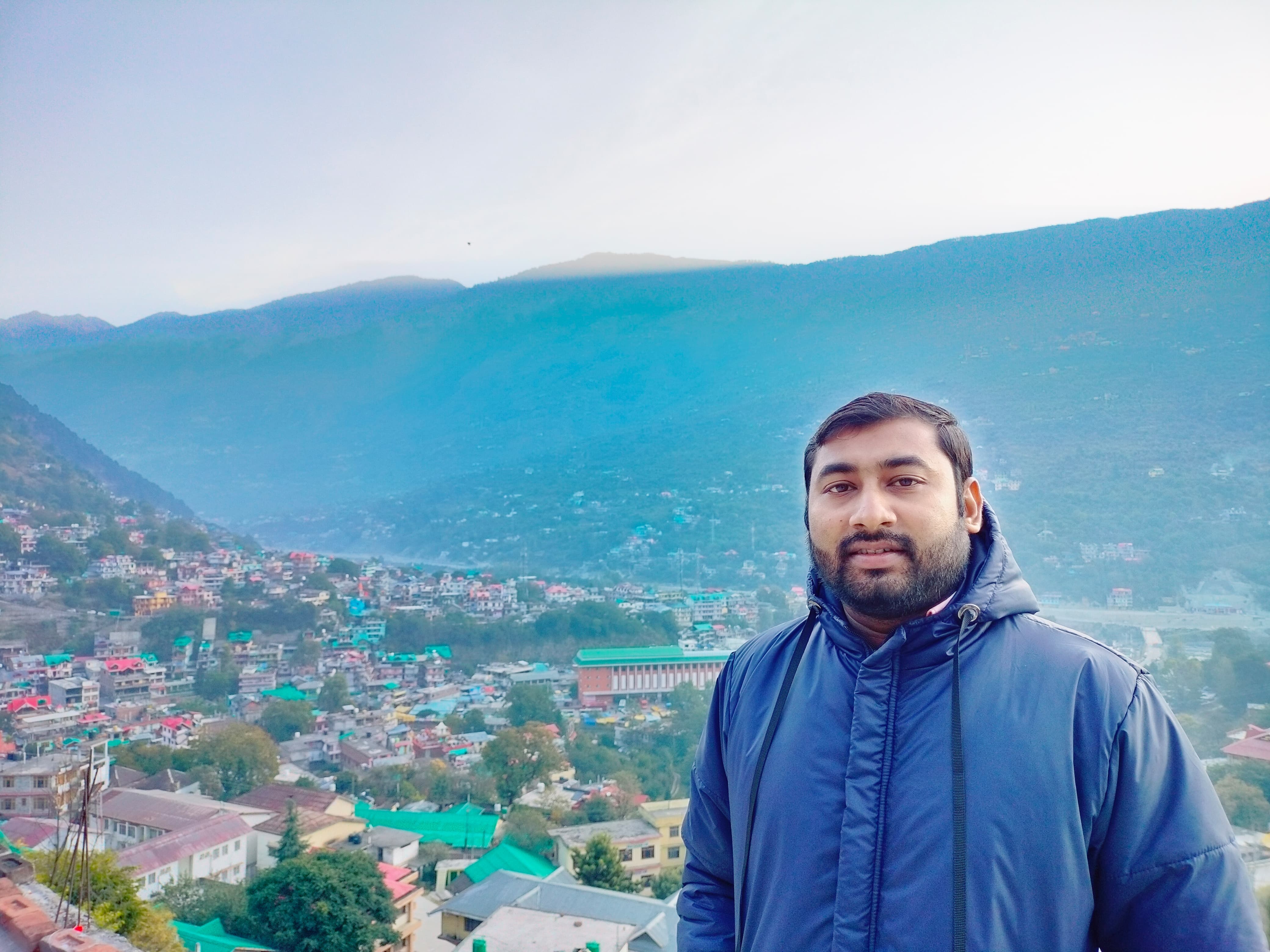
I am an Assistant Professor at the Department of Geography, Shaheed Bhagat Singh College, University of Delhi, New Delhi with a PhD degree in Urban Planning from Vidyasagar University. Before joining the faculty position, he worked as a Research Associate (RA) in the Department of Geography, Delhi School of Economics (DSE), University of Delhi, New Delhi for 6 months. Later he joined as a Post-Doctoral Fellow of the Centre for Technology Alternatives for Rural Areas (CTARA), Indian Institute of Technology, Bombay. He also served as a Contractual Whole Time Teacher (CWTT) for one year at the post-graduation department of Bajkul Milani Mahavidyalaya (Affiliated by Vidyasagar University), West Bengal. One of his recently published articles on “Sustainable Ecotourism Development using SWOT-QSPM Approach” is considered as “Best Impressive Research Paper” in the field of Tourism conducted by “Environment Science and Green Energy” at Hampton, Hilton Paris Clichy, Paris, France. He has already published 21 research articles (High Impact factor and reputed Scopus indexed journals specifically Elsevier and Springer), 3 Books, 2 Edited Books in Springer, and Scopus Indexed 3 edited book chapters. He has already presented his research works at 12 International Conferences, 6 National Seminars, 2 State Level Seminars and also done 4 certificate courses on Global Hydrological Modelling (Canfield University, UK), NIDM, Govt. of India (GOI), CBP at Jawaharlal Neheru University (JNU), Application of Geospatial Techniques in Modern Research (CEED, New Delhi). Besides teaching, he has already developed and enhanced a unified novel approach, known as Prediction-Adaptation-Resilience (PAR) approach to manage the future urban landscape development for small or medium scale cities sustainably.
Department of Geography
Vidyasagar University
Midnapore, West Bengal
India, Midnapore-721102, India
Period: 2018-2022
Department of Geography
Vidyasagar University
Midnapore, West Bengal
India, Midnapore-721102, India
Period: 2014-2016
Department of Geography
University of Kalyani
Period: 2011-2014
Department of Geography
Shaheed Bhagat Singh College
University of Delhi
Sheikh Sarai, Phase-II,
New Delhi 110017, India
Period: April 2023 - Present
Bajkul Milani Mahavidyalaya, Vidyasagar University,
Purba Medinipur, West Bengal.
Period: July, 2017 – June, 2018
Centre for Technology Alternatives for Rural Areas (CTARA)
IIT Bombay, Powai, Mumbai 400 076,
Maharashtra, India
Advisor: Prof. Parmeshwar D. Udmale
Period: January, 2023 - April, 2023
Research Associate, Department of Geography,
Delhi School of Economics, University of Delhi,
New Delhi-110007,India
Advisor: Dr. Netrananda Sahu
Period: September, 2022 – January, 2023
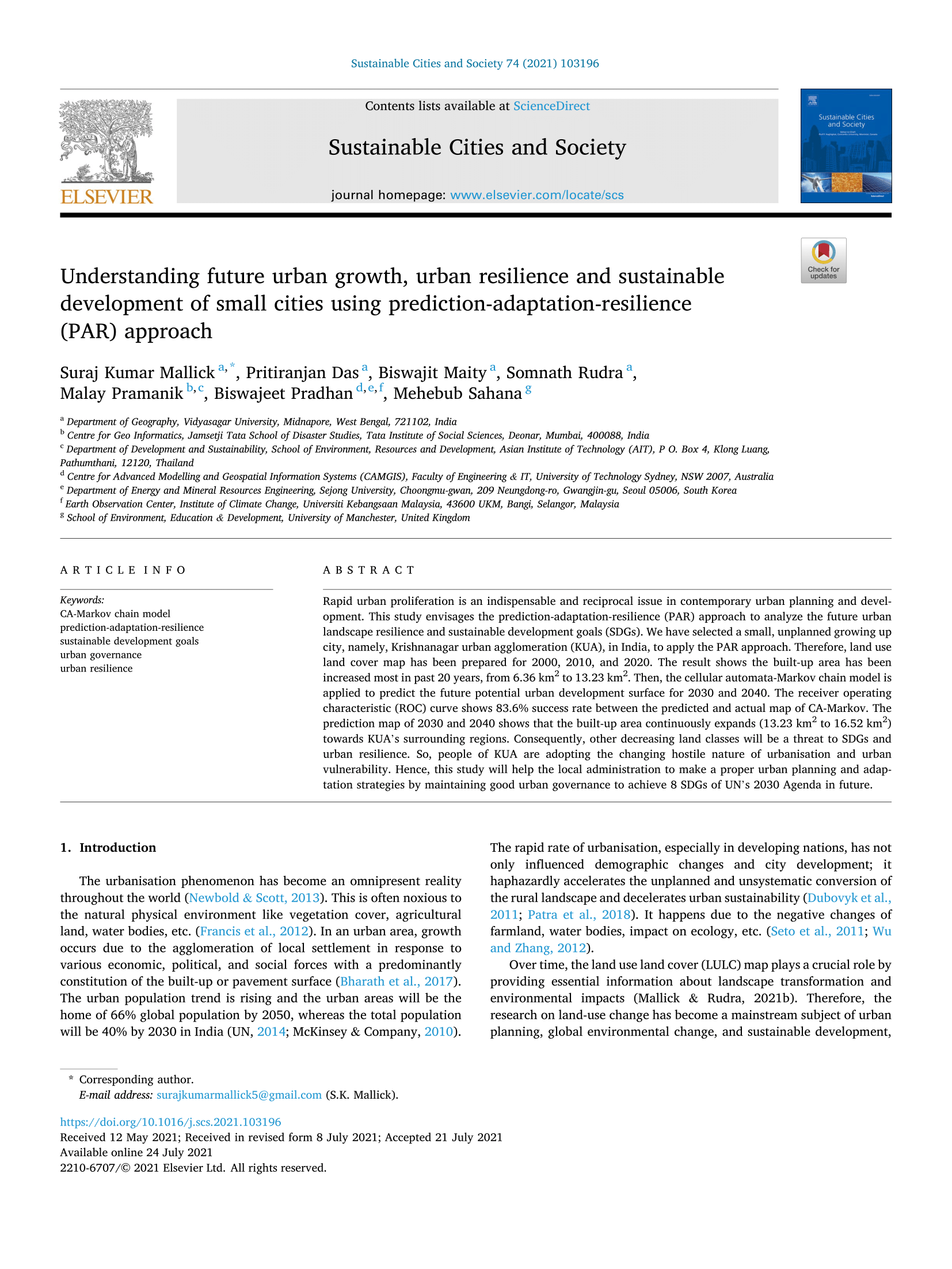
Rapid urban proliferation is an indispensable and reciprocal issue in contemporary urban planning and development. This study envisages the prediction-adaptation-resilience (PAR) approach to analyze the future urban landscape resilience and sustainable development goals (SDGs). We have selected a small, unplanned growing up city, namely, Krishnanagar urban agglomeration (KUA), in India, to apply the PAR approach. Therefore, land use land cover map has been prepared for 2000, 2010, and 2020. The result shows the built-up area has been increased most in past 20 years, from 6.36 km2 to 13.23 km2. Then, the cellular automata-Markov chain model is applied to predict the future potential urban development surface for 2030 and 2040. The receiver operating characteristic (ROC) curve shows 83.6% success rate between the predicted and actual map of CA-Markov. The prediction map of 2030 and 2040 shows that the built-up area continuously expands (13.23 km2 to 16.52 km2) towards KUA's surrounding regions. Consequently, other decreasing land classes will be a threat to SDGs and urban resilience. So, people of KUA are adopting the changing hostile nature of urbanisation and urban vulnerability. Hence, this study will help the local administration to make a proper urban planning and adaptation strategies by maintaining good urban governance to achieve 8 SDGs of UN's 2030 Agenda in future.
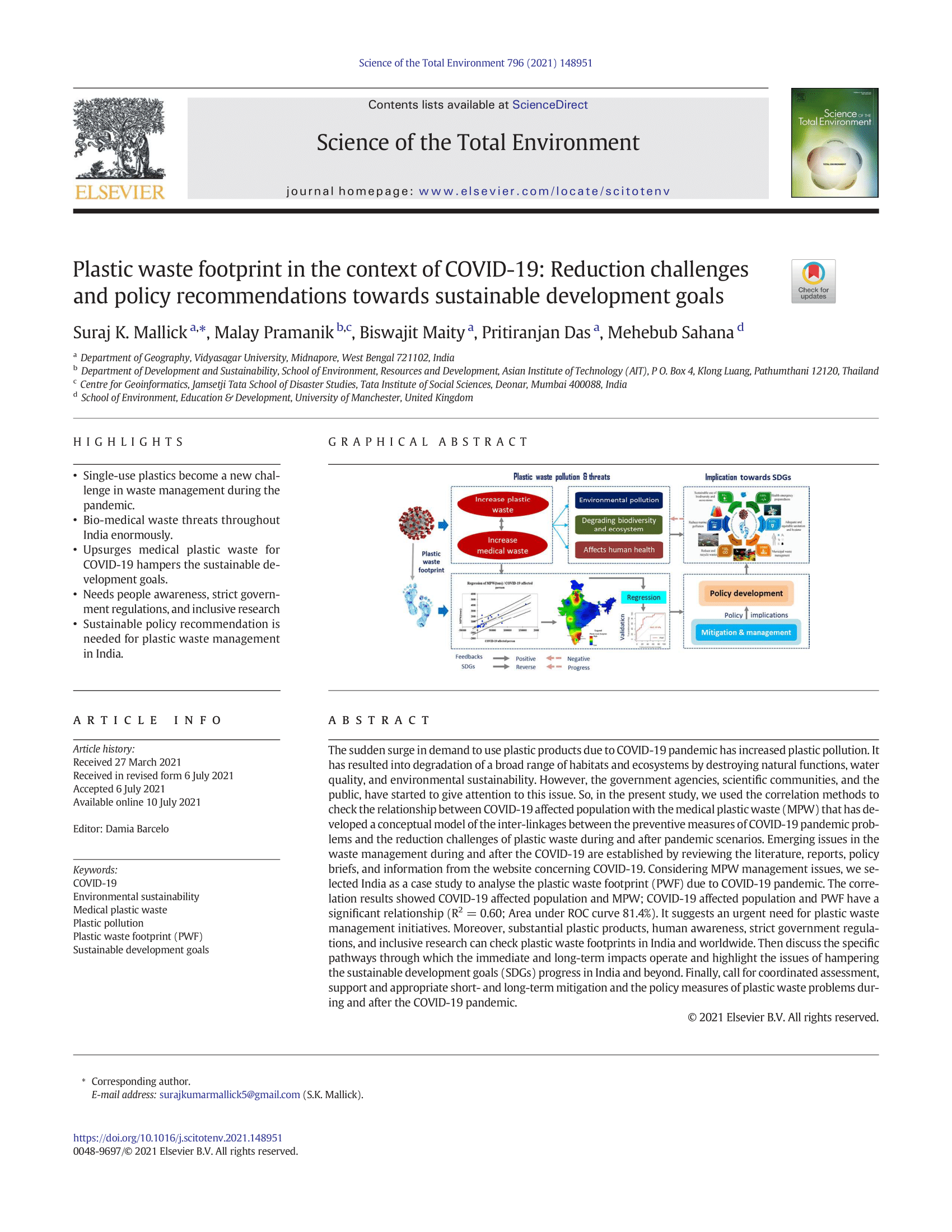
The sudden surge in demand to use plastic products due to COVID-19 pandemic has increased plastic pollution. It has resulted into degradation of a broad range of habitats and ecosystems by destroying natural functions, water quality, and environmental sustainability. However, the government agencies, scientific communities, and the public, have started to give attention to this issue. So, in the present study, we used the correlation methods to check the relationship between COVID-19 affected population with the medical plastic waste (MPW) that has developed a conceptual model of the inter-linkages between the preventive measures of COVID-19 pandemic problems and the reduction challenges of plastic waste during and after pandemic scenarios. Emerging issues in the waste management during and after the COVID-19 are established by reviewing the literature, reports, policy briefs, and information from the website concerning COVID-19. Considering MPW management issues, we selected India as a case study to analyse the plastic waste footprint (PWF) due to COVID-19 pandemic. The correlation results showed COVID-19 affected population and MPW; COVID-19 affected population and PWF have a significant relationship (R2 = 0.60; Area under ROC curve 81.4%). It suggests an urgent need for plastic waste management initiatives. Moreover, substantial plastic products, human awareness, strict government regulations, and inclusive research can check plastic waste footprints in India and worldwide. Then discuss the specific pathways through which the immediate and long-term impacts operate and highlight the issues of hampering the sustainable development goals (SDGs) progress in India and beyond. Finally, call for coordinated assessment, support and appropriate short- and long-term mitigation and the policy measures of plastic waste problems during and after the COVID-19 pandemic.

R
ArcGIS

QGIS
TerrSet
Shaheed Bhagat Singh College,
University of Delhi,
Sheikh Sarai, Phase-II,
New Delhi 110017, India.